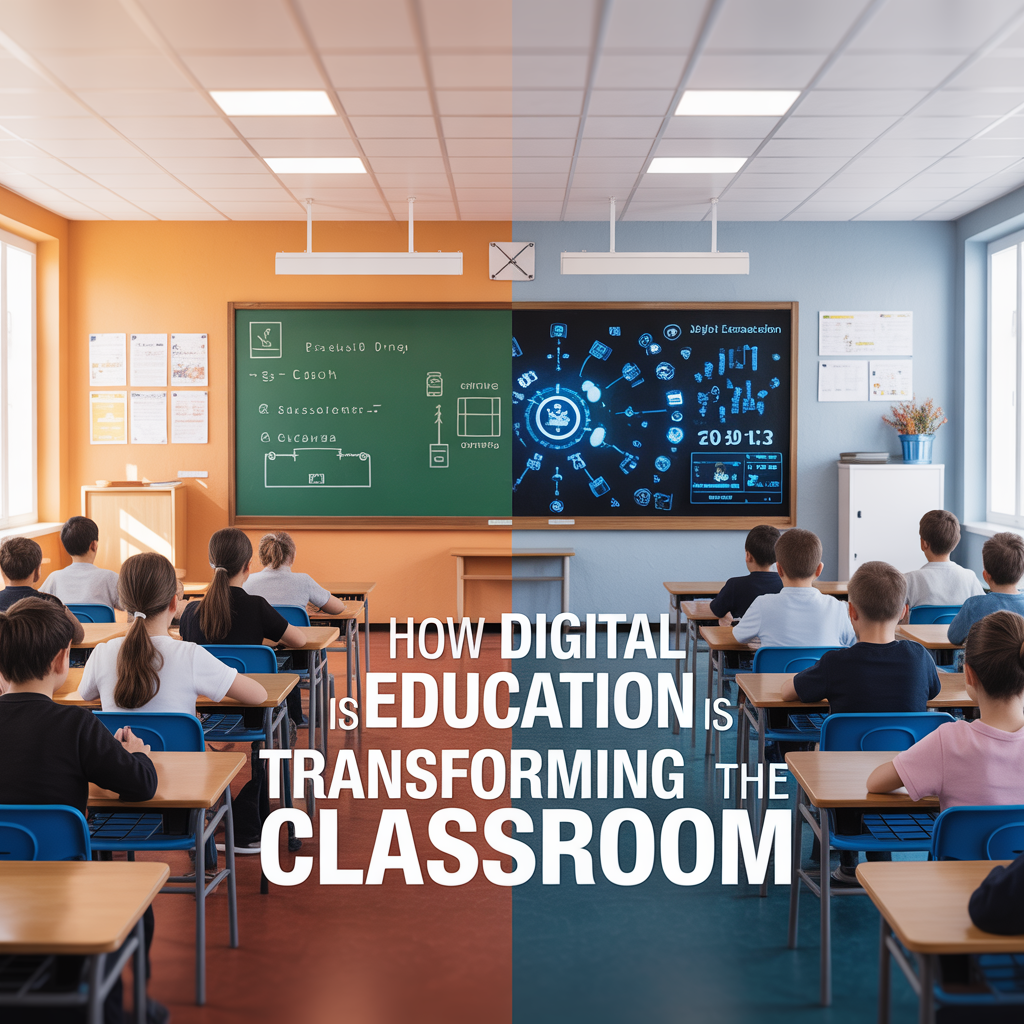
Nowadays, technology is making its presence felt in every field, and education is no different. Digital education has changed the concept of traditional classrooms. Earlier, students used to learn only with a board and chalk, but now they have laptops, tablets, and smart boards, which make learning more interactive and engaging. Online learning platforms like Google Classroom, Zoom, Khan Academy, and Coursera have allowed students to learn from home, which the whole world is taking advantage of.
Digital education has not only broken the physical boundaries but has also made accessing knowledge easier. Today’s student can study at any time, from any place, as per their wish. This flexibility is not possible in a traditional classroom. This is why both parents and teachers have started considering online learning as a powerful tool.
The COVID-19 pandemic also fast-forwarded this transformation. When schools were closed, digital education saved the education system. At this time, educational systems across the world have realized that digital tools have become a part of the future. This is not just a temporary solution, but has become a new standard.
This blog will explore the positive effects and benefits of this digital education, where we will see how these new methods are making learning easier and productive for students.
Rise of Digital Education:
The concept of digital education was earlier limited to a few people, but today it has become an integral part of every school and college. Earlier, students used to depend only on books and teachers, but now the internet and digital tools have opened the doors of knowledge for them. It has become common for every student to have a smart device, and teachers also use interactive platforms instead of traditional methods. Platforms like Zoom, Google Meet, and Microsoft Teams have created virtual classrooms where students are studying from home. Digital whiteboards, screen sharing, online tests, and assignments have virtually replicated the classroom. COVID-19 has played a big role in this transformation. When the world was in lockdown, online learning helped keep education going.
This period made everyone realize that digital education is not just a backup plan but the real solution for the future. Now, educational institutions are taking digital literacy seriously, and students are also being trained in new ways. This change has also created opportunities for students who were earlier deprived of learning due to a lack of resources or distance. Digital education has changed not only the learning methods but also the ways of thinking, ideas of access, and roles of teaching. This is a revolution that is evolving in new ways every day.
Key Benefits of Online Learning:
Online learning has made education accessible and convenient for everyone. Its biggest benefit is flexibility. The student can study according to his wish, be it morning or night. He has control of time, and if he does not understand a topic, it is easy to look at it again. Personalized learning is also a great benefit of this. Every student can access content according to their learning style. Online platforms use AI and analytics to provide materials to students according to their ability. Another advantage is that students can acquire knowledge from any expert in the world and join any course from anywhere.
This improves both the level and quality of education. Through online assessments and quizzes, students can get instant feedback on their performance, which increases their self-awareness. This system is also very useful for shy or introverted students as they can learn without hesitation. Apart from all this, travel and stationery costs are also reduced, which is a plus point for low-income students. Overall, online learning has made education more inclusive, cost-effective, and efficient. This system has also brought a new light for those students who earlier used to struggle in conventional classrooms.
Improved Engagement Through Multimedia:
The use of multimedia has proven to be a game-changer in education. When a student only listens to a lecture, his interest wanes over time, but when the same topic is explained through videos, animation, and interactive quizzes, he not only gets more engaged but also remembers it for a longer time. Visual content is more impactful for the human brain, and this is why multimedia tools have become very popular in digital classrooms. Now, students can easily understand boring topics like history or science through animated videos. Online learning platforms like Khan Academy, Coursera, and edX make concepts live and relatable by using these tools. Gamification is also adding new life to this field, where the learning process is designed like a game, which increases the motivation of students.
Tools like Augmented Reality (AR) and Virtual Reality (VR) are also being used so that students can experience things practically, like a biology student can take a virtual tour of the organs of the human body. Teachers are also using multimedia in their lectures to make them more interesting and engaging. Such interactive tools not only increase the focus of the students but also improve their understanding ability. The student of the digital age feels learning more from dynamic and visual content than from static content.
Teacher’s Role in a Digital Classroom:
The role of a teacher in a digital classroom has changed completely. Earlier, teachers were only knowledge imparters; now, they play the role of a mentor, guide, and facilitator. In this new system, their work is not limited to just writing on the blackboard. They provide interactive content to students, track their performance, and try to understand the unique needs of each student. Teachers make learning organized and accessible by using online platforms such as Google Classroom, Moodle, and Microsoft Teams. They get detailed feedback of each student’s progress through data, which allows them to work on each student individually. For this role, teachers also need to undergo continuous training and seek digital literacy, otherwise they may not be able to take full advantage of new tools and software.
A good digital teacher creates a student-centered learning environment and inculcates critical thinking and self-learning in students. He or she has to answer every question of the student, not just with theory but with examples, visuals, and real-life applications. This role is challenging, but if the teacher is updated and knows the right use of technology, he or she can revolutionize the learning experience of the students. Today’s teacher is not just an educator but also a digital navigator who prepares students for the future.
Accessibility and Inclusivity:
Digital education has brought a big change in the education system in terms of accessibility and inclusivity. Earlier, only those students could access quality education who lived in good places or had access to physical schools and colleges. But now with the help of the internet and digital tools, every student, be it in any city, village, or country, can get a quality education. This system is also proving to be very helpful for those who suffer from physical disabilities and cannot study comfortably in traditional classrooms. Tools like screen readers, subtitles, and adjustable text size have made learning easier for them, too. Online courses are also available in multiple languages so that students from every background can choose the material suitable for them.
Inclusivity also means that students from every economic background can access education because many platforms offer free or low-cost learning options. Now, even a student who lives in a remote area can access courses at universities like Harvard, MIT, or Oxford. This accessibility has made education global and borderless. Every student can learn at his/her own pace and does not have to face any limits or restrictions. Digital education has given equal right to learn to everyone, which was never possible before.
Challenges and Future Outlook:
While digital education has opened up many new avenues, there are also some challenges that need to be understood. The first challenge is the digital divide, not every student has stable internet or a modern device, especially in developing countries. Because of this, many students are not able to take full advantage of this system. Another issue is distraction; the home environment is not always conducive to learning, and students easily get distracted by mobile games or social media. Teachers also take time to learn new tools, and their training is not available everywhere. Another important issue is that of screen time. When children spend long hours in front of screens, it can hurt their health, such as eye pain, headaches, and fatigue. Despite this, the future of digital education is bright.
Technologies like Artificial Intelligence (AI), Virtual Reality (VR), and Augmented Reality (AR) are making this field more advanced. Personalized learning will improve further in the future, where every student will get specific content based on his/her data. Remote learning will be integrated with traditional classrooms through hybrid models. Governments and NGOs are also working on digital infrastructure so that every student has access to the internet and devices. If the challenges are solved in the right way, then digital education can become the most powerful learning tool in the world, which will open the doors of education for everyone.
Conclusion:
Digital education has not only changed the structure of the classroom but has also transformed the entire way of learning. Today’s student is not just a listener, but he actively participates, explores, and learns at his own pace. The Internet has made knowledge accessible to everyone, and digital platforms have opened up new avenues for those who previously stayed away from education for some reason. This system has made education more flexible, personalized, and engaging. But it also brings some challenges like digital divide, attention issues, and screen fatigue. It is our responsibility to find solutions to these problems so that quality education can reach every student.
The role of teachers is also central in this digital journey; they will have to learn new tools and create a modern learning environment along with students. In the future, as technology improves, learning will become more advanced and inclusive. Education will not be just limited to the classroom but will reach every home, every device, and every student. The need of the hour is to understand, accept, and use this digital revolution in the right way. If we use this platform correctly, we are not only moving towards a better future, but also creating new dreams and new opportunities for every student. Digital education is indeed the beginning of a new digital world.
FAQs:
1. What is digital education, and how is it different from traditional learning?
Digital education refers to the use of technology like laptops, tablets, smartboards, and online platforms (e.g., Google Classroom, Zoom) to teach students. Unlike traditional learning which depends on face-to-face classrooms and physical materials like chalkboards and books, digital education allows students to learn anytime and from anywhere, offering more flexibility and interactivity.
2. What are the main benefits of online learning for students?
Online learning provides flexibility, personalized content, and access to global experts and courses. Students can learn at their own pace, repeat lessons if needed, and receive instant feedback. It also reduces costs related to travel and supplies, making education more affordable and accessible for students from all backgrounds.
3. How has the role of teachers changed in a digital classroom?
In digital classrooms, teachers act more like mentors and facilitators than just instructors. They use digital tools to create engaging content, track student performance with data, and cater to each student’s learning needs. Teachers must also stay updated with new technologies and require regular digital training to be effective.
4. Is digital education accessible to everyone?
Digital education has improved accessibility greatly, allowing students from remote areas, different economic backgrounds, and those with physical disabilities to access quality education. However, challenges like poor internet connectivity and lack of devices still prevent some students from fully benefiting from it.
5. What is the future of digital education and what challenges does it face?
The future of digital education looks promising with technologies like AI, AR, and VR enhancing learning. Hybrid models combining online and traditional education are becoming popular. Still, challenges like the digital divide, screen time issues, and lack of teacher training must be addressed to ensure equal learning opportunities for all.